







One hardware ecosystem | An overview of our portfolio
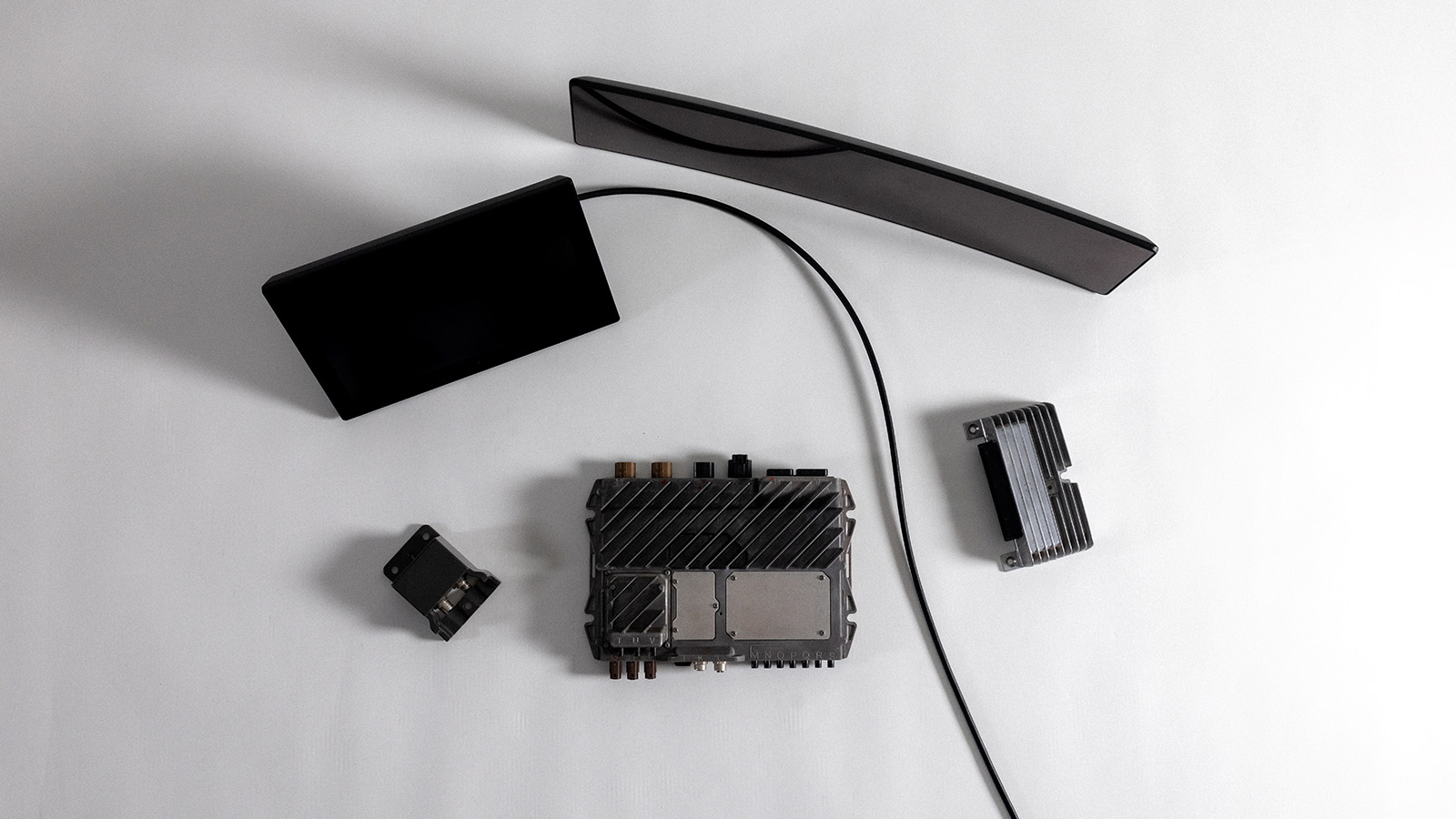
CPAC Systems offers a complete hardware ecosystem for industrial machines: a central ECU, operator displays, an inertial measurement unit, a control unit and cameras. Each product is built for harsh environments and can work on its own or as part of one system. This overview explains what each product does, its key specifications and how they connect.
Key takeaways
- Five product families cover computing, operator interface, motion sensing, control and vision.
- All products are designed for demanding conditions, with IP67 or IP6K9K protection and operating temperatures down to −40 °C.
- Standard interfaces: CAN FD, LIN, Ethernet, FPD-Link and GMSL2 make it possible to combine our products or integrate them with third-party systems.
- Together with Orbit, our software platform, the hardware forms the base of a software-defined machine.
Why machine hardware has to work as a system
A modern operator environment depends on many electronic units at once. Cameras feed displays, sensors feed control functions, and a central computer ties machine data, software and the operator interface together. When these units come from different suppliers, every connection becomes an integration project: different protocols, different software versions, different test standards.
The environment adds its own demands. Industrial machines work in rain, dust, mud and direct sunlight, with vibration and temperatures from deep frost to high heat. Components that work in a car or an office often fail here.
That is why we built our hardware as an ecosystem. The products are designed to the same environmental standards, use the same interfaces and are tested to work together while still being open to the systems an OEM already uses.
How the ecosystem fits together
At the centre is the Hydra ECU, which runs the operator environment and connects to the machine's networks. Displays present the interface to the operator. Camera F/S units send video to Hydra for situational awareness. The IMU2.1 provides orientation and motion data over CAN, and the APC handles control and I/O close to the machine's functions. Orbit runs on top as the software platform that manages data, diagnostics, configuration and updates.
The portfolio, product by product
Hydra ECU | the central node
Hydra is an automotive-grade ECU designed to act as the central node of a digital HMI system. It runs Android Automotive 12.1 on a Qualcomm Snapdragon SA8155P processor, with a dedicated NXP processor for the vehicle interface.
- Interfaces: 6 × CAN/CAN FD, 2 × LIN, 3 × 100BASE-T1, Ethernet 100BASE-TX and 1000BASE-TX, Wi-Fi and Bluetooth 5.0
- Peripherals: two display links (FPD-Link), four camera inputs, USB-C with DisplayPort
- Infotainment: AM/FM/DAB radio, 4 × 20 W amplifier, microphone inputs
- Optional backpack: LTE with two SIM slots and GNSS positioning (GPS, GLONASS, BeiDou, Galileo, QZSS)
- Environment: 8-32 V, −40 to +85 °C, IP67, fanless design
- Approvals: homologation approved in more than 60 countries
Display suite | 8", 12.8" and 24" curved
Our operator displays come in three sizes that share the same design language and robustness, so they can be combined in one cab.
- 8" | 1280 × 720, a compact display for secondary screens and dedicated machine functions.
- 12.8" | 1920 × 1080 (full HD), for machine control, operator assistance and system monitoring.
- 24" curved | 2 × 1920 × 720 with Mini LED backlight, for machines where the operator interface is central.
All three have projected capacitive touch that works with gloves, a brightness rating of 1,000 with ambient light sensors, optically bonded glass with anti-glare, anti-reflection and anti-fingerprint coating, and IP67 protection. They connect over FPD-Link III and are tested to ISO 16750 and IEC 60068 vibration standards.
IMU2.1 | orientation and motion data
IMU2.1 delivers accurate orientation and motion data for on-road and off-road machines, in real time over CAN (SAE J1939). It is calibrated for static and dynamic conditions across its full temperature range and keeps calibrating itself during operation.
- Accuracy: roll/pitch 0.05° RMS typical static, 0.5° RMS typical dynamic
- Range: angular velocity ±250 °/s, acceleration ±16 g, output rate 4-100 Hz
- Environment: 8-32 VDC, −40 to +85 °C, IP6K9K
- Reliability: MTTF 264 years (Siemens SN 29500)
- Applications: machine control and guidance, slope and grade control, levelling, load weighing, stability and rollover monitoring
APC | control and integration
APC is a multi-purpose control unit for safety-critical control, I/O and gateway functions. It can be part of a complete CPAC Systems solution or added to an existing vehicle architecture.
- Communication: 6 × CAN FD, wake on CAN, 2 × SENT, LIN
- I/O: analogue, digital and frequency inputs; high- and low-side PWM outputs up to 4,000 mA, with closed-loop current control
- Safety: designed for safety-critical applications, including hard-wired output enabling
- Environment: 12 and 24 V systems, −40 to +85 °C, IP6K9K, tested to ISO 16750
Camera F/S | situational awareness
Camera F/S is an HD camera for monitoring the area around a machine. Its wide-angle lens reduces blind spots, and together with Hydra and the displays it supports surround views and automatic view changes.
- Image: 1280 × 960, field of view 190° horizontal × 150° vertical
- Video link: GMSL2 at 3 Gb/s, with power over the coax cable
- Environment: −40 to +85 °C, IP6K9K, integrated heater that keeps the lens clear in cold conditions
- Size: 45 × 45 × 35 mm

What building a hardware ecosystem has taught us
The environment sets the specification. A display that is clear in an office can be unreadable in direct sunlight, and a connector that works in a car can fail after a season on a worksite. That is why brightness, sealing, temperature range and vibration testing are starting points in our designs, not options.
Interfaces matter as much as performance. A powerful component is of little use if it is hard to connect. We use established automotive and industrial interfaces like CAN FD, LIN, automotive Ethernet, FPD-Link, GMSL2, so our products fit into the architectures OEMs already have.
Operators use machines differently from engineers. Gloves, rain on the screen, a quick glance while driving. Touch that works with gloves, anti-glare glass and camera views that change automatically come from watching how machines are actually operated.
OEMs rarely replace everything at once. Most start with one product and add more over time. Designing every product to work both standalone and as part of the ecosystem makes that step-by-step path possible.
Choosing the right combination
We support OEMs from early concept to series production, including vehicle integration and safety-critical functionality.
What's next
We continue to develop the portfolio and will cover each product in more depth in Insights.
Frequently asked questions
What hardware does CPAC Systems offer?
CPAC Systems offers the Hydra ECU, a Display suite with 8", 12.8" and 24" curved operator displays, the IMU2.1 inertial measurement unit, the APC control unit and the Camera F/S. Together they form a hardware ecosystem for industrial machines.
Can CPAC Systems hardware be used with third-party systems?
Yes. Each product can work standalone, be combined into a complete CPAC Systems solution, or connect to third-party systems through standard interfaces such as CAN, CAN FD, LIN and Ethernet.
Are the products suitable for harsh environments?
Yes. The products are rated IP67 or IP6K9K, operate down to −40 °C (−30 °C for the 8" and 12.8" displays) and up to +85 °C, and are tested to standards such as ISO 16750.
Do the operator displays work with gloves and in sunlight?
Yes. All displays have projected capacitive touch that works with gloves, high brightness with ambient light sensors, and optically bonded glass with anti-glare and anti-reflection coating.
What is the Hydra ECU used for?
Hydra is the central node of a digital operator environment. It connects displays, cameras and machine networks, runs the user interface and infotainment, and is the hardware base for the Orbit platform.
Explore the hardware
See the full hardware portfolio with datasheets for each product, read about Orbit, or contact us to discuss which combination fits your machine.